
How to choose a low-voltage and network contractor: the quote and the contract
Two quotes for the same network and video surveillance can differ in price several times over. Usually it is not that one contractor is greedy: the cheap quote is missing something, and it surfaces during installation as extra charges. Here is what to check in a quote, which signs should put you on guard and what to fix in the contract.
What a quote should contain
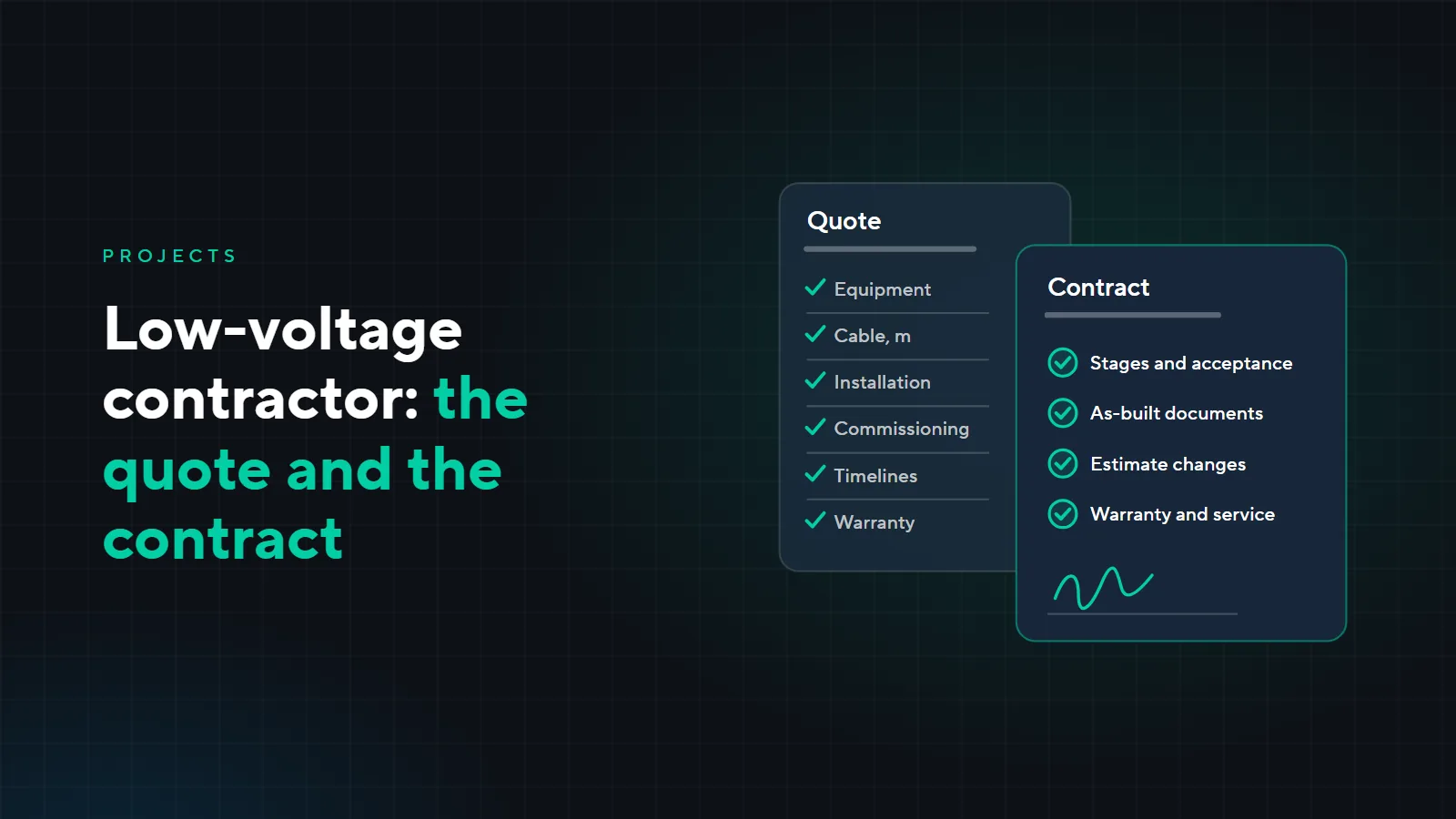
- A specification. Equipment models, quantities, cable length, cabinets and materials. A single line saying “turnkey video surveillance kit” cannot be compared with anything.
- Work listed separately from equipment. Installation, commissioning and materials on separate lines. You see what you are paying for and what changes if the equipment changes.
- A design and a layout. A good quote is based on a site survey: where the cable routes run, where the cabinets, cameras and access points go. If a quote is built on a number of points given over the phone, its figures are guesswork.
- Timelines, stages and warranty. Stages with dates, the warranty period for installation and for equipment, and a separate list of what the price does not include.
Warning signs
- A price without a site visit. A total “per point” over the phone, with no survey of the site. Cable route lengths, cabinet location and installation difficulty cannot be judged by eye, so the difference comes back later as extra charges.
- Too cheap. The quote is far below the others. The difference is usually what it leaves out: a lower cable category, conduits and trays, cabinet installation, configuration. Compare quotes line by line, not by the total.
- No as-built documentation. The contractor does not promise layouts, a cable log and test reports. Without them the next engineer will be looking for cables blindly, and there is nothing to argue installation quality on.
- It is unclear who does the installation. Everything is subcontracted and the contractor will not take responsibility for the result. Ask who will work on site and who answers for timelines and quality.
What to fix in the contract
- Stages and acceptance. A sign-off for each stage and what is checked at acceptance: that the systems work, the video archive, every cable line tested with an instrument.
- As-built documentation. Layouts, the cable log, test reports, equipment passwords and settings as part of the handover. Without them a stage does not count as handed over.
- Changes to the estimate. Extra work and equipment only with written approval and a price before the work starts.
- Warranty and service. Warranty periods for installation and for equipment, the day they start, how quickly the contractor comes out under warranty and who services the system after handover.
Example: two quotes for one office
A fictional office with 40 workplaces: network and structured cabling, video surveillance and Wi-Fi. Two quotes came in, and the first is noticeably cheaper. Let us compare them point by point:
| Item | Quote A | Quote B |
|---|---|---|
| Basis | number of points as stated by the client | office survey and floor layout |
| Equipment | “8 cameras, a switch”, no models | models, quantities, cable length, cabinet |
| Work | one sum together with equipment | installation, commissioning and materials separately |
| Timelines | not stated | by stage, with dates |
| Warranty | “included” | a period for installation and for equipment |
| Handover | not stated | layouts, cable log, test reports |
A line-by-line comparison shows that quote A has no conduits and trays, no cabinet installation and no Wi-Fi configuration, and does not mention cable at all. All of that would have to be paid for along the way, and the total would match or exceed quote B. Quotes can only be compared fairly when they are built on the same site layout.
How we work
- A quote after a survey. We visit the site and prepare a layout and a quote with a specification, work listed separately and timelines by stage.
- Who installs. Our own team of engineers and installers does the work. On large sites we bring in trusted partners, and we answer to the client for the result.
- Payment. An advance for equipment purchase, a payment on delivery to the site, and the final settlement 15–30 days after final acceptance. The stages are described in detail in “How we run a project: from survey to handover”.
- Warranty and handover. The warranty on installation work is 12 months; the terms and the start date are fixed in the contract. What the handover package includes is described in “Structured cabling: installation mistakes that are expensive to fix”.
How much it costs
The price depends on the site and the set of systems, so we quote it after a survey. The survey is paid; we quote its price after a call.
Collecting quotes for a network or low-voltage systems? Leave a request: we will call back, ask about your site and arrange a survey. See our work on the “Low-voltage systems” page.