
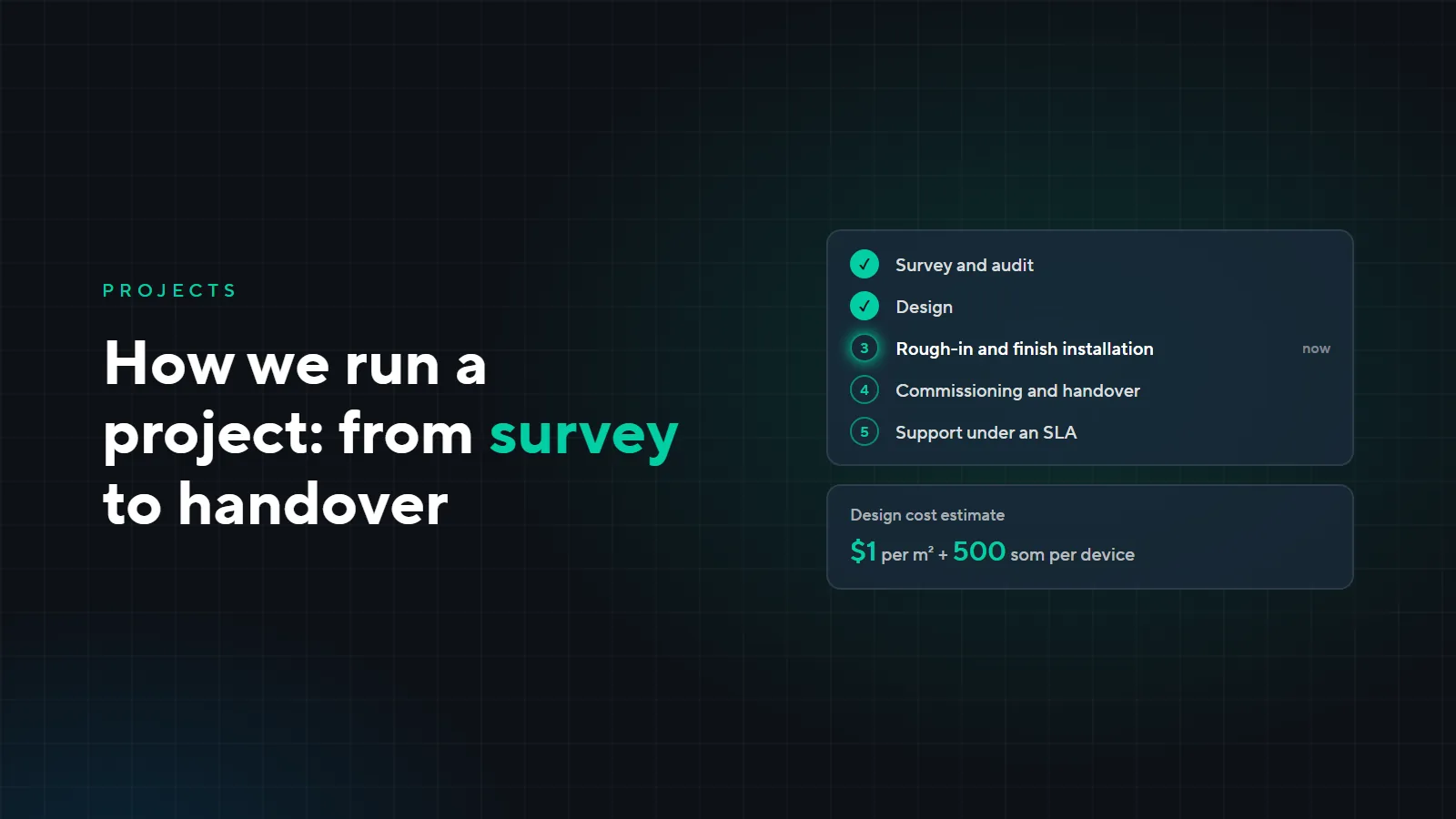
How we run a project: from survey to handover
Low-voltage systems, networks and servers end up inside walls and ceilings. A design mistake is later fixed by tearing open the finishes, and a setup mistake is discovered when the system is already needed. That is why every project of ours follows the same path, from the survey to support after handover. Here is who works on it, what happens at each stage and what it costs.
- 1Survey and audit
- 2Design
- 3Rough-in and finish installation
- 4Commissioning and handover
- 5Support
Who works on the project
The team depends on the size of the project. On a large site it can include:
- a personal manager, your contact for every question;
- an assigned designer;
- a personal engineer;
- a person in charge on site;
- an approvals team and a technical support team.
Every task is logged in our internal help desk system, so no request gets lost in a chat. Response times follow the contract and our internal regulations. If a project needs a special way of working, we agree on it individually.
1. Survey and audit
On the first call we look into the task and tell you where to start. A site visit and an audit are paid.
2. Design
You can order the design from us on its own, without installation. We price it for the specific site, and for a first estimate there is a simple formula: $1 per square meter plus 500 som for each end device, such as a camera, a reader or a network outlet. If floors are identical, we design the layout once, and the client does not pay for it twice.
If another company does the installation, we can supervise the project as technical supervisor or installation lead.
The best time to bring us in is during the building design stage. We have joined projects at different stages, and the rule is the same: the later, the harder the implementation and the fewer options remain. Once the walls are closed, a cable route goes not where it is convenient, but where it fits.
3. Installation
Installation runs in two passes alongside construction. Rough-in happens while walls and ceilings are open: we lay routes and cables and install cabinets. Finish installation comes after the interior work: cameras, readers, outlets and the equipment in the cabinets. Every line is labeled and entered in the cable log, so years later any engineer can find the right cable.
4. Commissioning and handover
We set up every system and test it under load. Every cable line is checked with a tester, and the results go into the test reports under the line number. For video surveillance we check the actual archive depth, and for access control, every entry scenario.
At handover we provide the as-built documentation, including diagrams, the cable log, test reports and settings, and train the staff.
5. Support
After handover we can take the site on for support under an SLA: scheduled visits, equipment checks, technical support. If you have your own specialist, we will hand the system over with documentation and keep helping on request.
Example: a hotel with a sports complex
The site is fictional, but the numbers are our real 2026 rates. A 120-room hotel with a sports complex, 7,000 m².
| System | Scope | Estimate |
|---|---|---|
| Design | 7,000 m², 536 end devices | ≈ 0.9 million som |
| Video surveillance | 96 cameras, 4 MP, 30-day archive | ≈ 2.1 million som |
| Access control | 40 doors: rooms, sports complex, service areas | ≈ 1.4 million som |
| Network and structured cabling | 400 ports, switches, cabinets, firewall | ≈ 5.8 million som |
| Total | ≈ 10.2 million som |
Turnstiles for the sports complex, Wi-Fi, a time tracking license and support are quoted separately. The timeline of a site like this follows the construction schedule: design before rough interior work starts, rough-in alongside it, finish installation and commissioning after the interior work and before opening. For comparison, a small site such as a restaurant goes through the whole path in 45–60 days.
Payment and warranty
- Payment: an advance for purchasing equipment, a payment upon delivery to the site, and the final payment 15–30 days after final acceptance.
- Warranty: 36 months on Hikvision equipment, 12 months on other equipment and installation work.
Planning construction or renovation? Leave a request at the design stage: you will have more options and fewer redos. See our work on the “Low-voltage systems” and “Case studies” pages.