
Access control for business centers and complex sites: access levels, stages and price
An access control system is often pictured as a door with a lock and a card. On a commercial site the job is harder: you have to decide who can go where and when, and make those rules work on their own, without a guard at every door. Here are the access scenarios we build, how a project runs and what it costs.
What access control solves
A few examples from our projects:
| Site | Access task |
|---|---|
| Sports complex with a hotel | Visitors only reach the services they paid for, athletes only the sports complex, hotel guests everywhere, and staff have their own access levels. Entry by biometrics, a central server, and the system keeps working autonomously if the connection to the server is lost. |
| Industrial plant | Many employees, several checkpoints, access managed by the security service. Access control also keeps track of working time. |
| Gas station chain | Several offices with different access zones inside and a large network of branches across the country in a single system. |
| School | More than 300 children; parents get a notification when their child arrives and leaves. Children grow fast, so recognition photos have to be updated often. |
There are special scenarios too: one-time biometric access for a visitor, or VIP access that opens only after a responsible person confirms it.
How access works in a business center
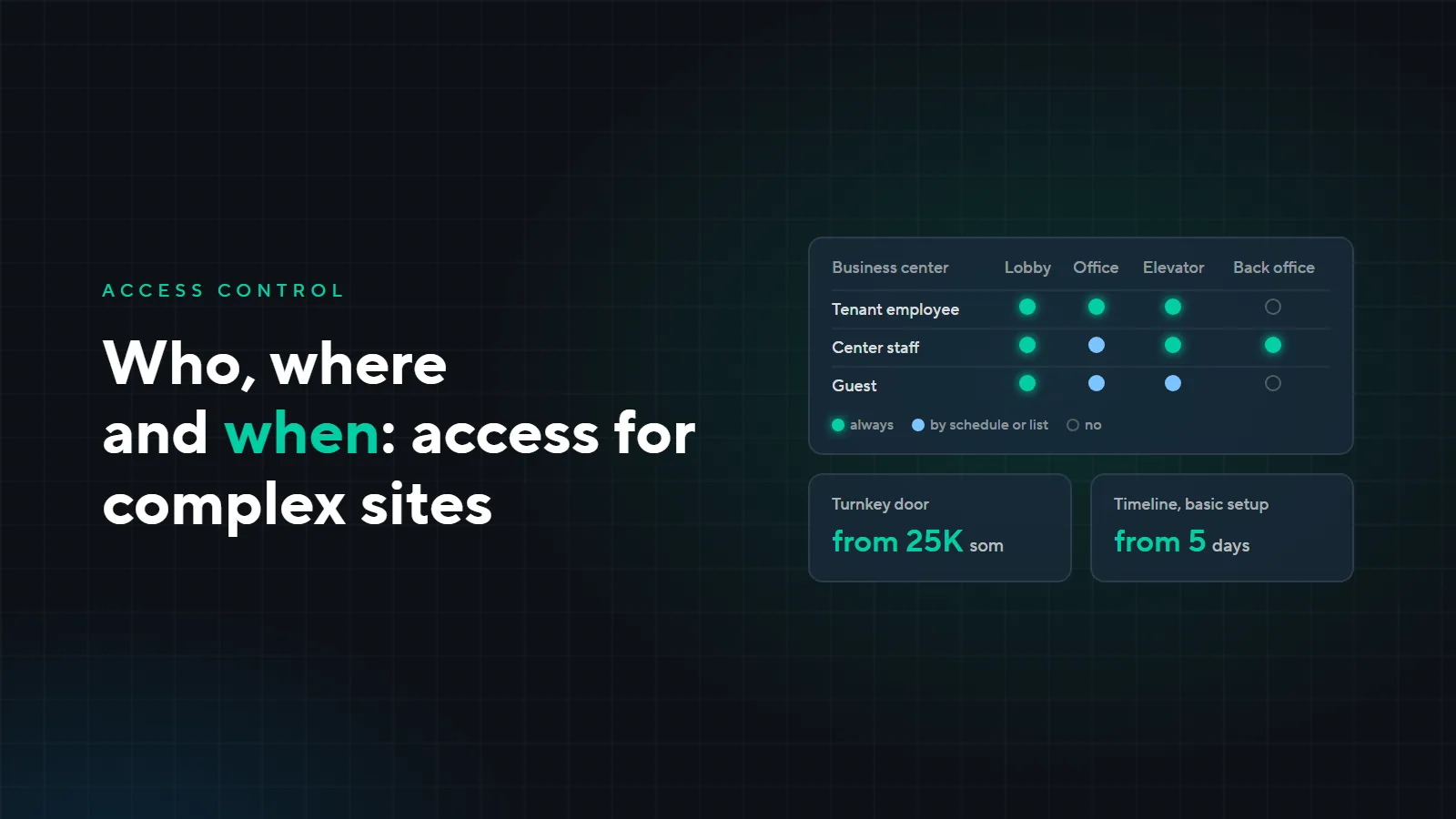
In a business center, access rules are agreed with the tenants. Zones are usually split like this:
- Open areas: the entrance and lobbies, open to everyone.
- Back office: business center staff only.
- Tenant offices: free access during working hours, by list only after hours.
- Elevators: by biometrics.
- Guests: with guest cards.
Access is issued by an administration employee at the reception desk. It can also be done remotely: the tenant sends a photo of the employee to a work chat, and access is set up without a visit to reception.
How people get through: face, card, wristband, QR
We prefer biometrics: a face cannot be handed to someone else or left at home like a card. But the system works with any credential, including cards, wristbands, QR codes and palm recognition, and they can be combined.
An example of a combined scenario from a sports complex: a visitor passes the turnstile by face and opens a locker in the changing room with a wristband. On the way out, the system will not let them through until the locker has been opened.
How a project runs
- 1Access scenarios together with the client
- 2Site survey
- 3Implementation plan
- 4Installation
- 5Commissioning, tuning and handover
We work out the technical specification together with the client. The main thing we need at the start is the access scenarios. To describe them, answer these questions:
- Which groups of people are on site: employees, tenants, guests, contractors, customers?
- Which zones are there, and where can each group go?
- When do the rules apply, and what changes in the evening and at weekends?
- Who issues and revokes access, and how are guests registered?
- Do you need working time tracking at the same entry points?
In a basic scenario, implementation takes from 5 days.
Typical mistakes
- The equipment is installed but the system is not set up. There is no management system, and people are entered manually on each device. It is inconvenient to use, and in the end nothing works.
- Poor installation. Outdoor devices get soaked by rain and snow and malfunction.
- Basic access control logic is missing. For example, there is no closed perimeter: the manual release button can easily be reached from outside, and the door opens without any credential.
What it costs
One turnkey door costs from 25,000 som, usually about 35,000 som. The price includes a reader or terminal, a lock, an exit button, a door sensor, a controller, installation and setup. Turnstiles and modifications to door leaves are quoted separately. For example, a business center with 20 controlled doors comes to roughly 0.5–0.7 million som.
Doors with a complex profile, custom design and high-security sites where access control is the key requirement cost more. Autonomous operation, special installation and special equipment are also quoted individually.
Working time tracking runs on the same terminals: a UKEY Time license starts at 4,500 som per month. For schools there is School Tracker with notifications for parents.
Need access control for your site? Leave a request: we will work out the access scenarios with you and survey the site. See more of our work on the “Low-voltage systems” page.