
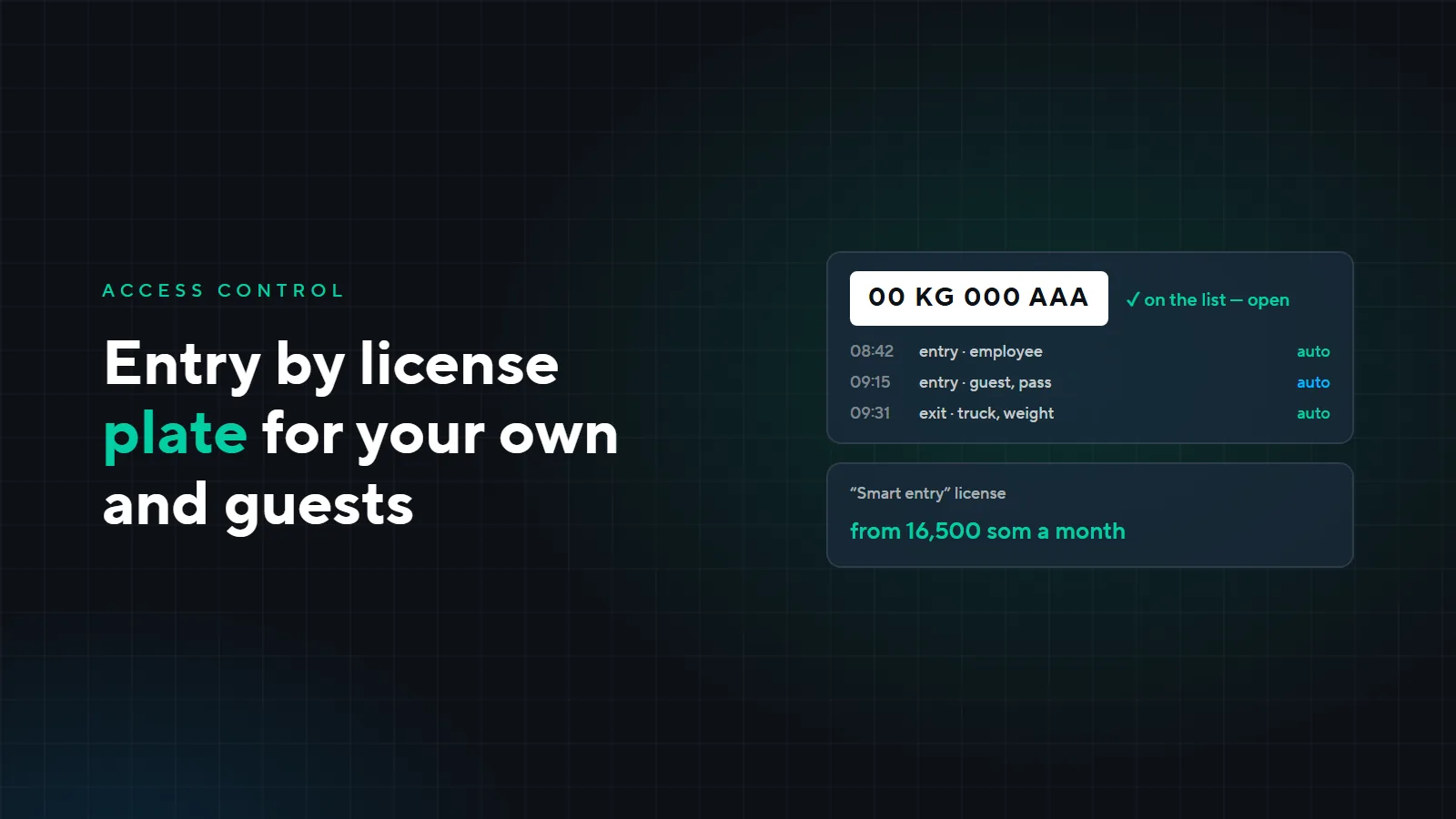
License plate recognition and barriers: entry for your own and guests
A guard walks out to every car, writes the plate in a log and calls to check whether to let it in. There is a queue at the gate, and a month later nobody can find who came in and when. License plate recognition removes this manual work: it lets your own vehicles in automatically, guests by pass, and stores every entry with a photo. Here is how it works, where it fits and what happens when a plate cannot be read.
How it works
- 1The camera reads the plate
- 2The system checks the plate against the list
- 3The barrier opens without a guard
- 4The entry, with a photo, goes to the log and Telegram
It is not limited to barriers: the system also controls gates or chains, and the dashboard shows entries and exits by day and hour, plus the status of the equipment.
Where it is needed
- Business centers and residential complexes. Tenants' and residents' cars pass by list, guests by temporary pass.
- Warehouses, depots, plants. A log of truck entries and exits with photos, and at the weighbridge the weight is tied to the vehicle's plate right away.
- Resorts and hotels. Guests drive in without waiting at the gate; the plate is added for the length of their stay.
- Paid parking. Entry and exit by plate, payment via elQR from a phone, no tickets and no cashier at the lane.
How guests get in
- Temporary pass by plate. The guest's plate is added in advance for the required period, and the barrier opens for it automatically.
- Security opens remotely. When an unknown car arrives, security sees its photo and opens the barrier from the dashboard or from Telegram. This entry is logged too.
When the plate cannot be read
Dirt, snow, darkness, a foreign plate — all of this happens. That is why:
- A plate recognition camera with IR illumination reads plates at night too. We set its mounting angle and distance in the design, since they determine how reliably plates are recognized.
- Manual opening with a photo. If a plate is not recognized, the operator sees a photo of the car and opens manually, and the entry is still logged.
- Safety radar. The barrier will not come down while a car is under the arm.
Example: an industrial site
An anonymized example from our practice. At the entrance to an industrial site there is a checkpoint with plate recognition cameras, barriers, radars and a queue display. At the weighbridge, cameras recognize the vehicle on the scales, traffic lights tell the driver when to drive on, and the weight is recorded against the plate automatically. Security does not have to write anything down: who passed, when and with what weight is all in the log.
What it costs
- “Smart entry”: a license of 16,500 som a month for up to two lanes and 8,000 som a month for each additional one. With annual payment, 12 months for the price of 10. Launch within 10 working days.
- “Automated parking”: 100,000 som for connection, then a percentage of the parking lot's monthly turnover: 15% for the first 12 months, 10% from month 13.
Equipment and installation — barriers, cameras, radars, cable runs — are quoted separately for your entrance.
Want to get rid of the queue at the gate and the paper log? Leave a request: we will look at your entrance and propose a setup.